Signed in as:
filler@godaddy.com
In this chapter, we’ll focus on transforming your research ideas into a compelling and engaging GRC presentation that captures the attention of judges and audiences alike. From organizing your thoughts to fine-tuning your message, we’ll work on crafting a narrative that not only informs but inspires.
Before we dive into this week, I want to share some words of wisdom from Prescott Vayda, a PhD candidate in paleontology at Virginia Tech in Blacksburg, Virginia. (That's Prescott in the photo to the right.) Prescott competed in the university’s Nutshell Games in 2022 and 2024. He admitted:
"I forget what it’s like to be someone that doesn’t just inherently know what every rock is that they walk past and thinks about it in their day-to-day life. I can say a lot of things about my fossils, but it’s not going to stick with the audience. That’s why I realized I needed to have a broader message that still relates to my research and is critical to my research, but isn’t so reliant on background knowledge."
What Prescott is describing is a phenomenon called the “Curse of Knowledge.” It happens when we forget what it is like not to know what we know. The “curse” is on us as presenters and speakers. It is very difficult (if not impossible) to un-learn and un-know everything we’ve spent years learning and knowing. And that’s okay. The important thing for you to remember is that your audience will not know what you know, and so you will have to design a message that speaks to them at their knowledge level.
If you are wondering how to do it, that’s our next task.
I’m going to go ahead and warn you now: This is a dense week.
Why?
There is no question that your narrative is the most intellectually demanding component of your talk. It requires experimentation, iteration, and testing to ensure that your thoughts are organized and compelling. Here’s how your script will unfold over the coming weeks: You will do a first draft, read it, and change 60% of it without consulting anyone. Then, you’ll run it by a friend who will promptly identify at least three words they do not know, so you can try to find ways to avoid those words or re-express them. Later, you will practice with another friend who will suggest you use an analogy to explain your central concept, and you will re-work it again.
But I’m getting ahead of myself. Let's start by looking at the tasks you will accomplish this week.

To achieve your goals in Week 2, you will need approximately five hours to complete the exercises. This includes a buffer for tasks that take longer than estimated or for unexpected follow-up work:
Access Week 2 exercises here.

As I developed the Take First! program, I interviewed over a dozen individuals from around the world who had competed in a GRC. One of my questions for them was, “What was the most difficult thing about preparing for the competition?” Several of them responded that designing the story was the most intellectually challenging. Dirk Lauinger, PhD, a postdoc at the Massachusetts Institute of Technology replied: “ The hardest part was to come up with the story, polish the story, and choose what story to tell. Practicing [the script] is mechanic[al] - with enough time everyone can do it. Deciding on what’s a good story, that’s what is difficult.”
Echoing Dirk’s perspective, Iris Garcia-Pak, a PhD student in neuroscience at the University of California at San Diego, shared that “the hardest thing was being able to share my project when the background is so inaccessible. I was trying to think of things that everyone experiences and even with the club analogy, not everyone goes to the club. I feel the first part, the hook, has to be applicable to everybody.”
When I was teaching research communication at the University of Virginia, I experimented with different types of tools to develop research narratives. Over time, I identified one tool that lends itself to our goal of succinctly sharing our research with non-specialist audiences: the And-But-Therefore, or the ABT.
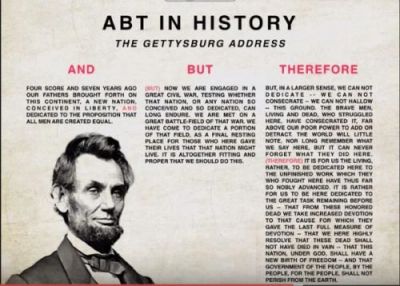
Championed in science circles by marine biologist-turned-filmmaker Randy Olson, the ABT is a narrative framework that focuses on key elements and organizes them as a story. Here is a silly example:
Last month, we took a day trip to the mountains for a hike. AND to prepare, we packed our hiking boots, filled the gas tank, AND bought gourmet sandwiches—ready to conquer nature and Instagram it. BUT just as the mountains came into view, a ranger waved us down to say the trail was completely washed out by a flash flood. THEREFORE, we ate our sandwiches in the car while Googling “top hikes near me” and ended up walking a quarter-mile loop behind a gas station. We called it “an immersive urban nature experience.”
I bet you are wondering: How can I use this simplistic formula to describe my highly complex research?
While I am a fan of the And-But-Therefore as a tool, my PhD students and I found that it is somewhat simplistic for research, so I have revised it for scientific and scholarly users.
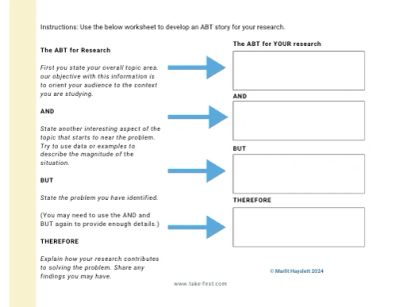
First, let’s start by looking at the blank ABT for Research worksheet below. The left column contains the guidance for the content needed in the right column that you should fill in.
Based on the three main elements of the ABT (And, But, Therefore), I developed the ABT for Research Worksheet to organize and visualize your thoughts.
In the first section, you briefly describe your overall topic area. For example, if you are studying sea level rise in Venice, Italy, you might start with some historical data about where sea levels have been over time. Or depending on your overall study, you might compare Venice to other places around the world also experiencing sea level rise. There is a lot of flexibility with regard to how you handle it, but your objective is to orient your audience to the context you are studying. This is an excellent opportunity to share any data you have. Testing with your audiences later will help you know if you have adequately addressed this point.
AND
Now, you are beginning to introduce the problem you have identified. Try to use data or examples to describe the magnitude or scale of the situation.
BUT
This is where you explain the problem you have identified.
THEREFORE
This is where you show your brilliance and share how your research is addressing the problem. This part of the narrative can include findings if you have them, and/or the next steps in your process.
WARNING: As you are developing your ABT, try to resist the urge to go into abundant detail about your methods. It is appropriate to state "My experiments revealed that..." or "My content analysis showed the following..." or "The results of my survey indicate a trend....". Please do not try to detail the experimental design or list your survey items. We believe you. :-)
Check out Exercise 2.1 to use the ABT on your research.
Now that we are acquainted with the structure of the ABT for Research worksheet, let’s look at an example from my own dissertation research. (You will find this example in the ABT for Research Worksheet.)
My PhD synthesized my interests in science policy and international affairs with science communication. My research question asked: how do governments use science to inform public policy? To focus my study, I compared the European Union (E.U.) and the U.S. on three specific cases (cyclamate, hormone-treated beef, and bisphenol-A). I conducted a content analysis of over 150 policy documents, looking for themes of risk to the economy, risk to the environment, and risk to human health.
The initial AND is where you share the background information. In my case, I start with the E.U. and the U.S., and their economic relationship to each other. I sprinkle in some data details to signal that this is a big deal that could have strong ripple effects to both economies and their citizens. Even if we don’t yet know what I’m talking about, we know 15 million jobs and $5.5 trillion is not trivial.
To build my case, I add some data points using another AND.
Then, to enhance the tension and announce the problem, we transition to the BUT. In my research, I found two distinct mindsets for regulating risk. From the perspective of only one country, my analysis may not cause concern. But in comparing two major trading partners, and noting that they view risk differently, the issue has the potential to cause trade conflicts. As you can read above in my ABT for Research worksheet, each jurisdiction approached risk with a different priority. The E.U. prioritized risk to public health while the U.S. prioritized risk to the economy.
THEREFORE, Marlit? (This is the important question which explains why the research matters.)
The analysis matters in the real world because the distinction can empower international economic negotiators to be mindful of the differing priorities as they build trade agreements. This awareness can help them to choose language that will resonate with one another and seek out compromises that are respectful of both sets of political, economic, and social priorities.
Now, as your content starts to flow, also be mindful of your choice of words. That reflection leads to the need to think about whether our disciplinary terminology—better known as jargon—is suitable for general audiences.
Jargon. If you don't think you have it, you probably do. As a PhD student in molecular biology with a focus on leukemia immunotherapy, Eliška Jandová (FameLab in 2022, 1st place, Charles University, Czech Republic) affirms this challenge: “At the beginning it was quite hard. I wrote down this text, but I wrote it as a scientist, not a science communicator. So, it had these difficult terms. I passed it to my mother and my boyfriend. And I was like...do you understand? They were like, ‘Oh, what is this?’”
As a brief review, “jargon” is the term we use in English to describe specialized language. It is often obscure, technical, and uncommon to many audiences. Jargon can be single words, expressions, acronyms, and abbreviations that:
While jargon is beneficial for communicating quickly with your immediate colleagues, most of your audiences will not be your co-workers and peers. For audiences that do not share your technical background, jargon creates distraction and confusion, leading to a lack of understanding. On a personal level, it could also make someone feel unintelligent or excluded because they are not familiar with the terminology.
So how do we handle this situation? Next we are going to learn techniques for identifying and modifying jargon.

There are two big steps to managing jargon. First, you need to know when you are using jargon. Once you know you are using it, the second step is to modify it.
How do we know when we are using jargon? After years of studying jargon (nerd alert!), I have learned that jargon has a few characteristics that make it easy to spot. For example, long words or expressions that are difficult to pronounce are a classic red flag for jargon. They are usually obvious and easy to identify.
Jargon can also be sneaky. There are many words that mean one thing in normal day-to-day conversation but have a different meaning in the context of research. One example is the word “property.” In non-scientific conversations, this word refers to things we own such as houses, cars, planes, etc. However, in scientific terms, a property refers to physical or chemical characteristics that can be observed and measured such as speed, freezing point, color, etc. Same word, two very different meanings.
Why is this point important, Marlit?
Good question. The answer matters because if your audience hears you speak a word they are familiar with, they are likely to process that word with the day-to-day definition. As you continue to speak, if they are listening with the wrong understanding, they will not grasp your overall research message.
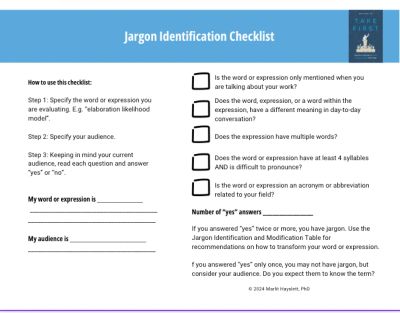
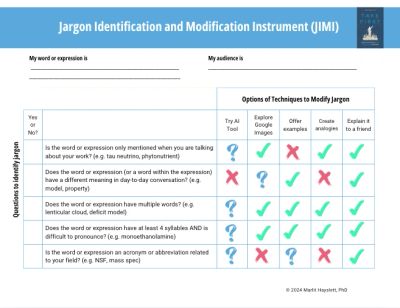
To know when you have jargon, start with the Jargon Identification Checklist. It is a quick and easy tool to evaluate whether you will need to spend some time finding new ways to express yourself.
Use Exercise 2.2 to identify potential jargon in your research.
Now that we know we have jargon, how do we modify it into language our audience will understand? It’s not as hard as it seems, but it requires a combination of experimentation and testing. At this point, let’s turn to my Jargon Identification and Modification Instrument (aka JIMI) to develop ideas about how to modify technical or scientific terms.
JIMI is a tool I developed that shows you the options at a glance for modifying jargon. Based on your responses to the Jargon Identification Checklist, JIMI gives you suggestions for which modification techniques are likely to yield alternative language for your jargon.
Here is a short description of each of the jargon modification techniques.
Try AI Tools: Ask your favorite AI assistant “What is a different way to say (insert jargon here)?” Or “Explain (insert jargon here) in plain language.” As an example, I asked ChatGPT to explain carbon sequestration in plain language. Here is an excerpt of the response it gave me: “Carbon sequestration is like nature’s way of taking carbon dioxide (CO₂) out of the air and storing it. The goal…is to slow down climate change by keeping extra CO₂ out of the atmosphere. It’s like putting carbon in a vault and locking it away so it can’t cause trouble.” This explanation is an effective modification because the result is an analogy (i.e., the vault) that most people should recognize.
Explore images: Sometimes a picture does a better job explaining a concept than more words. Try entering your jargon into a photo repository (e.g., Google Images, Vecteezy, Unsplash, etc.). Do any of the search results provide ideas of how to restate the jargon?
Offer examples: Sometimes you can avoid using the jargon if you can provide illustrative examples. In my dissertation, one expression that met the threshold for jargon was “precautionary principle.”[1]It is a policymaking concept made popular in Europe, and the basic idea is that if you are unsure of the consequences of a product, process, or service, it is prudent to wait for more evidence of safety before allowing its widespread use. An example of the precautionary principle at a personal level would be if you choose not to use voice recognition technologies (e.g. Alexa or Siri) because you are unsure how that data will be used or protected.
Create analogies: We will be going into a lot more detail in the next section about how to create your analogies. As a quick example, you can see that even the AI tool took advantage of an analogy when it described carbon sequestration as putting carbon into a vault.
Explain the word/term/expression to a non-expert friend: My favorite! In this technique, you explain your jargon to a friend who has a different disciplinary background. Then, they explain it back to you using their own words. They might explain it correctly, or incorrectly, but whatever happens, it will shine a light on the aspects of the jargon that are most difficult for a non-specialist audience to understand. Incorporate or modify your friend’s interpretation for your audience.
Ainul Huda, winner of the 2024 Nutshell Games at Virginia Tech (U.S.) emphasizes the value of this exercise: “ The activity that stuck with me is when you share your research with someone, and then they have to repeat back what you said in their own words. That helped me understand if the explanation didn’t work or if they completely misunderstood it. Some of it could be them, but a lot of it could be me.”
[1] Applying the Jargon Identification Checklist to the term precautionary principle, I can respond affirmatively to at least of three of the five questions. It is an expression I use only when talking about my research; the word principle has a different meaning in day-to-day conversation; and the expression has multiple terms.
If you found jargon in Exercise 2.2, use Exercise 2.3 to modify your jargon.
One of the most common techniques that I observe when watching GRC talks is the use of analogies.
An analogy compares something unfamiliar to a shared experience such as food, sports, music, or travel. Analogies are powerful tools for explaining scientific concepts because they connect unfamiliar ideas to familiar experiences, making complex information more relatable and easier to understand. By mapping the structure of a known situation onto a new one, analogies help bridge knowledge gaps, spark curiosity, and support memory retention. They can simplify abstract theories, clarify intricate processes, and engage diverse audiences from students to policymakers. Used effectively, analogies can transform technical content into something vivid and accessible—turning science into a story that people can follow.
Here are some examples from winning GRC talks:
When I was teaching, most of my doctoral students were from STEM fields such as chemistry, biology, engineering, and computer science. As a communications professional, I found myself quickly lost as they tried to explain their research: chemical proteomics, DNA extraction, eutrophication. I would raise my hand, stop them, and kindly ask, “Can you compare it to something I already know?” In other words: Please give me an analogy.
Over time, it became evident that I needed a repeatable process for creating an analogy to be able to guide my students more systematically. As a result, this process has allowed complex concepts such as chemical proteomics, DNA extraction, and eutrophication to become (respectively) the act of fishing, the complexity of the human body, and the effects of caffeine on aquatic ecosystems. Suddenly, things made a lot more sense.

Some people have a natural talent for coming up with analogies in the moment. Basic analogies are usually fine for casual conversation, but watch out for an analogy that may lose integrity when trying to explain something more complicated. When communicating scientific concepts with analogies, strive to maintain what I call “explanatory integrity.”
Wow, Marlit! What is this magical idea of “explanatory integrity?”
Thanks for asking! Explanatory integrity ensures that your analogy is appropriate and clear to the audience. I describe it as having “levels” of comparison. Let’s analyze an actual example.
In the University of California’s 2024 Grad Slam, Iris Garcia-Pak, a PhD and MD candidate in Neuroscience, compared the brain to an exclusive night club. She suggested that like a night club, our brains can become crowded and loud with information, noise, and other inputs. This is her first level of comparison.
To enhance her analogy, she then introduced the blood-brain barrier—identified as the “bouncer,” or the person who is responsible for keeping the people in the club safe. This is her second level of comparison. Knowing that a bouncer’s job is to prevent inappropriate people from coming into the club, now we can connect the dots and expect that the blood-brain barrier is responsible for keeping harmful things out of the brain.
Can you see how the analogy is getting richer and explaining more? That is explanatory integrity.
Iris even took her analogy to a third level when she compared glutamate (jargon alert!) to messages in the brain. Having too little glutamate is like having no message to send, while having too much glutamate is like trying to talk in the club when the music is too loud.
In her conclusion, Iris asserts that her data supports the hypothesis that the bouncer escorts extra unwanted glutamate out of the brain, helping to prevent or manage neurological conditions such as anxiety and epilepsy.
Let’s explore how Iris built this terrific analogy with such strong explanatory integrity.

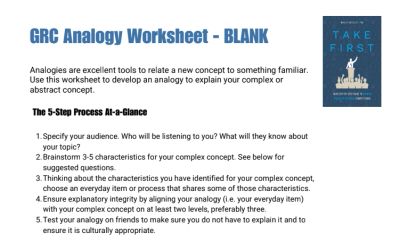
When developing an analogy for scientific or technical concepts, I recommend a minimum of two levels of explanatory integrity, and preferably three. Using my five-step process and the Analogy Worksheet, you can develop and test an audience-centered analogy for your concept. Let’s continue with Iris’s analogy to see how the process works.
Step 1. Specify your audience.
When communicating your research, the first step is to define and discover your audience (which you have already done in the case of your GRC). Discovering your audience matters because the way Iris would explain the blood-brain barrier to first-year medical students will differ from how she would explain it to her neighbors who may be business owners, chefs, and schoolteachers.
Step 2. Brainstorm 3–5 characteristics for the complex concept.
Physical characteristics that you can sense (see, touch, smell, etc.) are useful for simplistic analogies. For example, if we state that the Earth is like a peach, our comparison is based on the shape of the objects we are comparing. However, returning to Step 1 where we consider our audience, that basic analogy is only going to be useful for young children who are not yet familiar with planets.
Iris starts with a physical characteristic by comparing the brain to an exclusive night club, a physical location where people dance, drink, and talk. In other words, it is a busy place. Similarly, our brains are full of thoughts, ideas and questions, not to mention all the neurological tasks the brain is executing. For the first level, the characteristics shared by our two concepts are that they are busy environments.
For many scientific and technical concepts, the characteristics of the complex concept will be intangible. In the case of the blood-brain barrier, Iris chose to define one characteristic as the function or job. By choosing to compare it to a person with a specific responsibility (i.e., the bouncer), we can now assume that the function of the blood-brain barrier is to keep things separate. Adding a little nuance is the specific idea that the bouncer and the blood-brain barrier keep out things that are harmful. For the second level, the characteristics shared by our two concepts are that they have a function or a job, one task of which is to keep out harmful or inappropriate things.
For her third level, Iris introduces glutamate and compares it to the act of exchanging messages or information. She adds a layer of complexity when she mentions the amount of glutamate influencing the success or failure of the message delivery. For the third level, the characteristics shared by our two concepts are the idea of exchanging messages and the amount of information being exchanged.
To summarize, our task in Step 2 is to brainstorm characteristics of our complex concept. For Iris’s example of the blood-brain barrier, the characteristics she leveraged include a busy place, function, keeping out harmful things, exchange of messages, and amount.
We cheated a little in this example because we already knew what Iris had chosen as her analogy (i.e. the bouncer at the nightclub). However, if we did not already know, our next step would be to ask ourselves, what are some busy environments that need to keep out harmful things while they exchange information/messages?
Step 3. Thinking about the characteristics you have identified for your complex concept, choose an everyday item or process that shares some of those characteristics.
Now we get to choose our analogous concept. The foundational idea here is that your analogy should be familiar to your audience. In other words, an “everyday item or process”. Good categories to choose from are food, music, sports, travel, animals, nature, etc. Students often choose everyday items from cooking, transportation, and nature because most people can relate to those activities.
As we have seen, Iris chose to compare her complex concept of the blood-brain barrier to a bouncer at an exclusive nightclub. In our interview, she did share that she was a little concerned that not everyone would have experienced a night club. She took a calculated gamble that people either had direct experience or indirect experience through friends or movies. Since she won first place, her gamble paid off.
As you are making your choice for your analogy, be mindful that cultural differences may alter this generalization, particularly when it comes to sports and games as these activities may differ across countries and cultures. A few years ago in one of my classes, an American PhD student compared voice recognition technology (e.g. Siri, Alexa) to the children's game of Simon Says [1]. Because many of his peers were from other countries that do not play the game, the analogy did not work for his audience.
Step 4. Ensure explanatory integrity aligning your analogy (i.e. your every day item) with your complex concept on at least two levels, preferably three.
Revisiting Iris Garcia-Pak’s Grad Slam talk, her analogy had at least three levels:
Are you wondering why this level of detail and scrutiny are important? Good. The key reason is that if you use an analogy that is not well designed, it can lead to confusion, or worse, misunderstanding. In Iris’s analogy, if she had ended the analogy at the first level of the brain compared to a night club, the audience would have been left with questions about why she was comparing the two, and what it means. By enhancing her analogy with the additional levels, understanding increases, and we are better able to appreciate her research.
Step 5: Test your analogy on friends to make sure you do not have to explain it and to ensure it is culturally appropriate.
As researchers, we like to test things and make sure they behave as we expect. But we are human researchers, so we sometimes forget or run out of time to actually do the test. That’s why I expressly include this last and most important step to developing an effective analogy.
There are three main reasons why we should test our analogies with friends:
1. Does the analogy make sense without additional explanation? Imagine if Iris had needed to explain the concept of a night club before offering her comparison to the brain. In this case, the analogy would fail the friend test.
2. When you describe your analogy, what clarifying questions does your friend ask? Listen carefully to your friend’s feedback for ideas of how to improve the explanation.
3. Does your analogy align culturally, or does it confuse your friend (like the game of Simon Says)?
See Exercise 2.4 to create your own analogy.
[1] Simon Says is a game where one person calls out a command such as "raise your left hand", or "stand on your right foot", or "spin around". The key to the game is that the leader must say "Simon Says" before the command . If the leader does not say "Simon Says", the players should not move; if they move, they are out of the game.
Here are the key takeaways from Week 2:
1. Crafting a compelling narrative is the most intellectually challenging part of a talk.
Developing your script involves revisions, testing with non-experts, and using analogies to clarify abstract ideas. This process is iterative and takes time, but it’s crucial to making your presentation understandable and impactful.
2. The “And-But-Therefore” (ABT) framework is a useful starting structure for storytelling.
The ABT helps break down a complex research topic into three parts:
· AND: Set the context or background.
· BUT: Introduce the problem or conflict.
· THEREFORE: Present your resolution or research findings.
In concert, this structure encourages clarity, flow, and audience engagement.
3. Jargon is a major barrier to communication, and it often goes unnoticed by the speaker.
Use tools like the Jargon Identification Checklist and JIMI (Jargon Identification and Modification Instrument) to detect and rephrase technical language. Modify jargon using analogies, examples, plain language, and feedback from non-experts.
4. Analogies are powerful tools for explaining complex ideas.
Analogies link unfamiliar concepts to common experiences (e.g. food, travel, etc.). Effective analogies have “explanatory integrity”—meaning they remain accurate and helpful even when layered or extended.
5. There’s a process to building good analogies.
My five-step method for creating analogies improves the likelihood that your analogy will be both accessible and conceptually accurate. Strong analogies deepen understanding and improve retention for non-specialist audiences. Remember to leverage the Analogy Worksheet to help clarify your thoughts.
Check out the Week 2 Checklist and reflection questions.
Meet me in Week 3 to work on slides and props. Yahoo!