Signed in as:
filler@godaddy.com
This week is all about refining your presentation through focused, individual practice. Rehearsing on your own allows you to perfect your timing, smooth out transitions, and build confidence in your delivery. By dedicating time to solo practice, you’ll strengthen your connection to your material and ensure you’re fully prepared to shine on competition day.
When it came to rehearsing, Iris Garcia-Pak, 2024 winner of the University of California Grad Slam, shared her secrets: “ I rehearsed a ton. I rehearsed every single time I was in the shower. And then there were times at the lab where we would spend half of the day rehearsing in our meeting room.”
Another UC Grad Slam competitor Shannon Brady confessed: “Trying to have fun with it was the best advice that I had while I was rehearsing. My anxiety always says to me, ‘You’re gonna die if this doesn’t go well.’ I had to remind myself actively ‘No, you’re not [going to die]. It’s going to be fine.’ When I had fun with it, everything just fell into place, versus when I was putting pressure on myself to do well, it did not go well, and I did not have fun.”

To achieve your goals in Week 4, you will need approximately five hours to complete the exercises, including buffer hours:
Access Week 5 exercises here.

Throughout my career, I have given hundreds of presentations. They have included formal briefings to organizational leadership, testimony to state legislators, informal updates to colleagues, conference presentations, classroom teaching, and one dissertation defense. For all of them, including the classroom teaching, I did some level of rehearsal.
The first reason that I rehearse is to identify any disconnects in my narrative. When I write, things feel and sound one way. When I verbalize them, they feel and sound different. Without a rehearsal, I would have no way of discovering these hiccups.
The second reason that I rehearse is to work through how I want to deliver the information. Sharing facts and data is different than telling stories. Rehearsing helps me tune into the nuances and develop techniques for differentiating those parts of my talk.
Another reason that I rehearse is to prepare my “autopilot.” Have you ever noticed that when you drive somewhere for the first time it takes a lot more energy than once you know the way? Rehearsing helps build your personal “autopilot.” Good preparation means that when the “big moment” arrives to deliver your GRC talk, your “autopilot” is in the “on” position and knows where it is going.
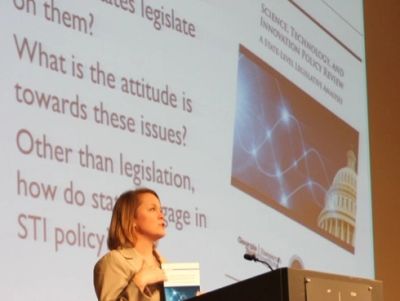
This week, you will do your first rehearsal with all the elements of your talk (also called a dry run or practice). You should plan to record it so that you can watch yourself and see what your physical presentation habits are. You do not need fancy equipment—a cell phone camera will work fine.
Your goal with this first, full rehearsal is to gather information. What type of information, you ask?
After you rehearse, make notes about all your reactions and things you want to change.
PRO TIP: I recently spoke with Harsh Khatwani, 3rd place winner in the University of Otago's (Dunedin, New Zealand) 2026 3MT competition. He shared that one technique he used for rehearsing was watching a video of a practice audience while he presented his talk. Having a fake audience helped simulate the real presentation environment. In particular, Harsh found that the practice audience videos allowed him to work on making eye contact — training himself to look up and hold a gaze rather than focusing on his notes or his slide.
Exercises 5.1 and 5.2 will guide you in setting up and recording your rehearsal.

I rehearse in my office at home. Sometimes, I will rehearse via Zoom and record myself to watch my performance and look for what I want to do differently. Ideas for other locations include:
In general, wear what makes you feel comfortable and confident. On the flip side, you do not want to choose an outfit that makes your audience feel uncomfortable. My best advice: As you watch previous GRC talk videos, observe what the speakers wear and compare it to your choices. One of your goals is to ensure that your clothes do not distract from what you are saying. Be you!
If you are genuinely unsure about what to wear, a safe choice is business attire. For men, that will be a pair of nice slacks, a long-sleeve button-down shirt, and a jacket. Consider adding a tie to finish the look. Women have more choices—dress slacks, or a skirt with an elegant blouse, or a professional dress.
From time to time, a GRC competitor will dress in a costume or outfit that brings more life to their research. This is not common because most GRCs do not allow costumes. If you are uncertain whether costumes are allowed and/or how a costume would be received by the judges and/or the audience, be sure to consult your local GRC organizers.

We are in Week 5, and so there should be parts of your talk that you can start to memorize. Continue memorizing aspects of the script you know you are keeping. If you are interested in memorization methods and techniques, here are a couple of resources.
Memorization Strategies from The Learning Center, University of North Carolina
Boost Your Memory: Top 10 Memorization Techniques

Mentally preparing for a rehearsal should be less stressful than the official event, but it may still be a little nerve-wracking. There isn’t a one-size-fits-all answer to this question, so you will need to discern the best approach for you. I’ll share a few thoughts about my process.
For a solo rehearsal with no audience, the main thing I need is to feel prepared. It means that my script is complete, and I have a starting idea of what I want to say, and how I want to deliver the talk both with my voice and my body language. Anticipating that my script will change, I prepare to record myself along with making verbal and written notes. Ideally, I prefer a private space where I won’t be interrupted. Also, I time myself to measure how long my speech is compared to my allotted time.
Aside from the mechanics of the talk itself, other things can help to reduce stress and calm your nerves. I can offer some suggestions, but you will know what works best for you. Here are my top ideas for reducing stress and managing nerves in the moment.
If you have five minutes for emergency nerve management, do one of these:
If you have 30 minutes to an hour:
If you have a couple of hours:
Exercise 5.4 helps you to make a plan for managing pre-GRC talk jitters.
For the purposes of your preparation, assume that the judges will use a rubric to evaluate all the competitors based on the same criteria. Competitions use different adjectives to describe what they are looking for, but all are trying to push the competitors toward achieving clarity, charisma, and connection.
Your GRC organizers will have the rubric for their event. It may not be common practice to offer the rubric to the competitors, but if you request it, they should provide it to you. If they decline to provide it, try asking a broader question such as "Can you tell me what criteria we will be evaluated on? Do any of the criteria weigh more than others?" In my opinion, you are entitled to know how you will be evaluated so you can properly prepare.
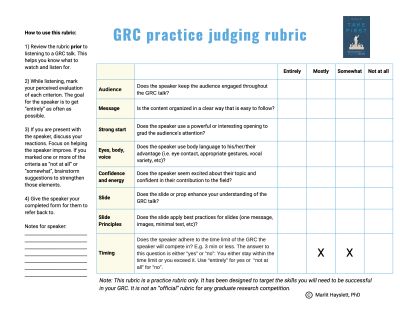
For the purposes of your preparation, I have created a practice rubric that focuses on the major elements of any GRC. You can find your GRC practice judging rubric here. I recommend you print a few copies as you will need copies for your rehearsal audiences. If you prefer a digital version, click here.
In the left-hand column, you will see 12 criteria that you will be judged upon. If you compare them to the Princeton Research Day rubric, or the 3MT rubric, or any other GRC rubric, you will see a lot of overlap. Categories may be labeled slightly differently, but all the concepts are present.
The second column from the left explains what you are trying to do. There is a prompt provided, “The speaker…” and then for each criterion a goal is laid out. For example, for the first criterion of “Audience,” the prompt reads: “The speaker keeps the audience engaged for the duration of the talk.”
The five columns on the right contain options of how well the speaker achieved that criterion, with choices ranging from “entirely” to “not at all.” Of course, your goal is to have your audience react very well so that the judges can mark “entirely” as often as possible.
Sidenote: Where the criterion does not apply (e.g., slide/prop not allowed by GRC) just mark “not applicable”.
Check out Exercise 5.5 to start using the practice rubric.
There are the key takeaways from Week 5:
1. Solo rehearsal builds confidence and mastery.
Practicing alone helps you fine-tune timing, transitions, and delivery while deepening your connection to the content. This repetition is what prepares your “autopilot” to kick in on presentation day so you can stay calm and in control.
2. Make rehearsal a habit—anywhere and everywhere.
Effective presenters use every opportunity to rehearse—in the shower, at the gym, walking to the lab, or even in front of a mirror. Consistency is more important than formality—frequent, casual practice pays off.
3. Record yourself and watch critically.
Your first dry run should be recorded so that you can evaluate things like time, pacing, flow, slide references, hand gestures, and filler words. These observations help you identify what to adjust and improve.
4. Manage anxiety by having fun and using mental resets.
Fun is a powerful antidote to stress. Use power songs, breathing exercises, or physical movement to ground yourself and ease anxiety. If you’re relaxed and enjoying yourself, your performance will improve naturally.
Remember to review the Week 5 Checklist and reflection questions.
In Week 6, we rehearse with friends. No fear -- your have your plan and you are prepared!
