Signed in as:
filler@godaddy.com
In addition to your research and visuals, YOU are a key part of the presentation. Your posture, gestures, and overall presence can amplify your message and captivate your audience. This week’s focus is on building confidence, practicing strong body language, and using purposeful movement to enhance your delivery. Combining all those factors will ensure that your command of the stage will leave a lasting impression on the audience.
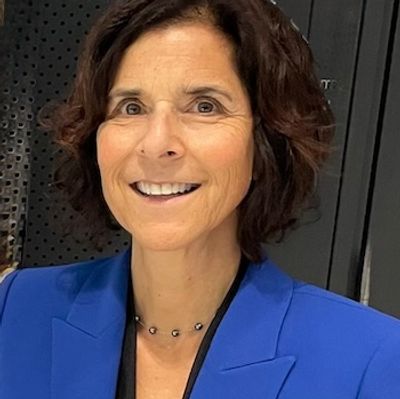
Pictured on the right is Amy Aines, co-author of Championing Science. After coaching hundreds of scientists and business professionals how to communicate complicated information, Amy offers the following advice:
“Your delivery brings your ideas to life! Your ability to vary your voice, gesture authentically, and emphasize the most meaningful words, has more power to engage and compel the judges than a solid script. Keep practicing until you speak with enthusiastic, heart-felt conviction.”
To achieve your goals in Week 4, you will need approximately six hours to complete the exercises. This includes a buffer for tasks that take longer than estimated or for unexpected follow-up work:
Access Week 4 exercises here.

Your physical presence is the way you stand, move, and speak while you are presenting. It is a key component of how the audience experiences you and your research. I could make an argument that it might be the most important.
Let's imagine: You have written the perfect script. You efficiently capture the context of your research, the problem you are solving, and how your solution will make the world an amazing place. You even drizzle in a touch of humor. You have designed the perfect slide with an attractive graphic that illustrates the optimal elements of your research results.
You take the stage to begin. You look out into the sea of 100-plus faces, and your mind goes blank. You recover, but the audience knows you are nervous. Your vocal quality has become monotone and lacks confidence. You are using a lot of filler words. You notice people in the audience losing interest and checking their phones. The judges have a quizzical look on their faces.
How do we prepare to avoid that moment?
Early in my career, I did not make an effort to learn how to speak to an audience. I wasn’t being deliberately stubborn or arrogant—I just didn’t know any better.
At a major event that included an audience of state legislators and business leaders, I had a 20-minute presentation in which I was sharing the results of my team’s research. After my talk, a stranger in the audience approached me. He did not introduce himself, but instead announced with frustration, “You talk way too fast.”
Yikes! That feedback was hard to hear. I had spent hours preparing that presentation. I had wanted it to be perfect. Even though I had rehearsed with my colleagues, their feedback had been focused on the narrative structure of the research results I was delivering. None of them offered feedback on my physical delivery at all.
In addition to speaking too quickly, over time I learned that I used a lot of filler words. I also discovered that my arm gestures looked like I was directing airplanes on the runway!
At this point in my career, I still have the tendency to speak quickly, use filler words, and wave my arms. But because I am aware of those issues, I plan ahead to minimize the impact on the audience.
Mastering your physical presence takes time and attention.
For the purposes of the GRC, I have a few tips to improve your vocal quality, body language, and confidence. There is no shortage of websites with advice about these topics, so feel free to search for more guidance if this subject is of interest to you.

Cultivating your vocal character can be difficult, but it is well worth the investment. I am working with a client now who speaks slowly in a monotone voice. If I want to take a nap, listening to him is a great idea. If I want to learn about his research, not so much.
Here are some generally accepted principles for developing your vocal character:
Use Exercise 4.1 to evaluate your vocal character.

Body language is the nonverbal communication conveyed through posture, gestures, facial expressions, eye contact, and movement. It often reveals emotions, attitudes, or intentions that words don't (or contradict what's being said). We use and read body language largely unconsciously.
Here are some ways you can tune into and intentionally manage your own body language:
Body language is a well-studied area of communication so if you are interested in more information, use your favorite search engine or AI tool to explore.

You were accepted into a graduate program because you are talented and ask interesting questions. Confidence isn't something you're born with — it's something you build, one presentation, one conversation, one small win at a time. The more you show up and do the work, the more you'll trust yourself to do it. You have spent years building expertise that most people don't have. Now it's time to build confidence in the person behind that expertise — because that person is more than enough. You are enough.

Confidence is a personal characteristic that describes your belief in yourself and your abilities. Some people are born with confidence, but most of us have to cultivate it through our experiences and accomplishments. Confidence, in contrast to arrogance, reassures the audience that you know what you are doing.
How do you build your confidence for a GRC?
Another aspect to mastering your physical presence is delivering a “strong start.” This technique persuades your audience that you have something to say that they want to hear. You are attracting them to listen to you. A good strong start captures your audience. An amazing strong start can inspire them.
Strong starts benefit both the speaker and the audience. One benefit is that the speaker can create a connection with the audience. Inviting them into your research story creates a sense of belonging.
Another benefit is that a strong start can boost the speaker’s confidence and energy for the rest of the talk. This is a definite advantage for the speaker, but guess what? Audiences much prefer a confident energetic speaker to a dull, nervous one. To sum up, strong starts are a win for everyone!
There are many choices for strong starts. Before I get into the options, I offer one universal piece of advice that applies regardless of which technique you choose. Consider using the word “you” to include your audience from the outset. What does it look like in practice? Here are some examples:
Tim Gordon of Exeter University opens his 2019 FameLab talk by suggesting to the audience that they are all fish looking for coral reef.
Merryn Baker of the University of New South Wales Sydney begins her 2022 3MT talk with a question: “What does your breath say about you?”
Kaylene Cooper of The University of Queensland opens her 2024 Falling Walls talk with something that sounds like a cross between a lyrical poem and rap song. Her nerves get the better of her, so the physical delivery is a little clumsy, but the idea is really intriguing.
Some strong start techniques will feel uncomfortable; some could even feel bizarre. But hopefully one of them will feel like a good fit for your personality and research. Let’s get into the options.
Did you know that in many countries, only 1%–3% of the population holds a PhD? According to data from the Organisation for Economic Cooperation and Development (OECD), the average share of 25- to 64-year-olds with a doctorate across OECD countries was around 1% in 2019.
Admittedly, the above factoid has no context and therefore is limited to an interesting point of trivia. That said, I bet you still found it interesting since you are (or you will be) among those PhD holders in the near future. And that’s the goal with any strong start—to catch your audience’s attention.
Opening your GRC talk with data or statistics is a powerful way to immediately capture a general audience’s attention and establish the real-world significance of your research. Numbers provide concrete context, helping listeners to quickly grasp the scale, urgency, or impact of a problem—even if they’re unfamiliar with the topic. For example, saying “Over 8 million tons of plastic enter our oceans every year” paints a vivid picture that sparks curiosity and concern. Well-chosen statistics can also lend credibility to your talk and signal that your work is grounded in evidence, making it easier for a non-specialist audience to engage with and trust what you’re saying.
Depending on the context, the data point could be large, small, or both. In her 2024 winning Falling Walls talk, Dina Rogers contextualizes her research by using data to explain the problem: Only 9% of a specific type of plastic is recycled, and the other 91% has a devastating effect on the environment. This is a dramatic and effective way to bring us into her message.
If you think using data is something you would like to try, experiment with simply verbalizing the information, versus displaying the data on your slides. Harking back to Week 3 with slide design, remember to avoid dense charts and graphs. One powerful technique I have seen is to simply put a number on the screen. Borrowing from my opening example about the number of PhD holders in the world, what if I opened my talk with a slide with “1%” in large font? Not only would the slide content be easy to read and comprehend, but it would create curiosity (and perhaps a little confusion). An effective speaker with a well-designed talk would guide the audience through the content, and the slide would be the back-up dancer it has always dreamed of being.

“We’ve arranged a society based in science and technology in which nobody understands anything about science and technology.”
~ Carl Sagan, American astronomer
Quotes are brief statements usually attributed to someone famous and/or prominent in their field. They are often inspirational or aspirational. Quotes can help set the tone or mood for your talk. The only “rules” about using a quote are to make sure it has an obvious connection to your topic, it is appropriately attributed, and that it is not too lengthy.
When I give talks about discovering your audience, I use a famous quote that civil rights activist and poet Maya Angelou made famous, but is actually from Carl W. Buehner, an American politician and religious leader: “[People] may forget what you said—but they will never forget how you made them feel.” The connection to my topic of audience discovery is that you want your audience to feel something that makes them remember what you said to them. I want my audiences to feel welcome, included, and valued.
Finding an appropriate quote can be a bit of a scavenger hunt. When I want to find a good quote, I start by going to a quotation database. Examples include Brainy Quote and The Quotations Page. Then, I try to search that database for the concept that I want to spotlight with the quote. Finally, I try to choose a quote from a person whom audiences will recognize (and a woman as often as I can!).
If the quote is perfect, but you aren’t sure that your audience will know the person being quoted, you can include details to situate the relevance of the person. For example, imagine you were presenting at an international science conference. You could use the quote above from Carl Sagan—well known in the U.S.—but he may not be as famous globally.
“Raise your hand if you have been affected by a flood in the past 10 years.”
This technique is an example of a strong start known as a “call and response,” which has at least two benefits. The first is that it gives you, the speaker, information about your audience immediately. If your research is about floods, a call and response such as the above will give you instant feedback as to how many people in your audience have experience with floods.
The second benefit is that a call and response creates connection with the audience. If I were in the audience, and the speaker said, “Stand up if you’ve been to Lyon, France,” I would immediately stand up. With this simple technique, my curiosity would be piqued about the speaker’s topic. (J’adore Lyon!)
The key to a successful call and response is to make the response options clear. In most cases, the best result is achieved when you keep the answer binary: yes/no; true/false; left/right; etc. The reason is that if you are speaking to an audience of 40 people, and you ask an open-ended question (like “How are you feeling today?”), it creates a bit of uncertainty regarding who should answer and how, which defeats your goal of attracting the audience because instead of engaging them, you may be confusing them.
Shannon Brady, winner of the 2024 University of California Riverside Grad Slam asked her audience: “Do you all ever talk to yourselves?” As she looked around the auditorium, she observed and announced “Ok, I’m seeing some heads nod.” If Shannon had tweaked her question slightly to include guidance for the audience to act on (e.g., “Raise your hand if you ever talk to yourself.”), she may have gotten a more accurate and impactful response. This is a minor tweak—remember Shannon still won!
In the case of your GRC talk, the time limit will likely constrain you to only one call and response. But know that in longer talks, you can sprinkle more call and response questions throughout your presentation to maintain connection and energy with your listeners.
If you are allowed to use props in your competition, a call and response can be doubly effective. For example, during her final presentation, one of my students held up a plastic water bottle and asked, “How many of you have drunk from one of these bottles?” Every hand in the room went up. Their response provided her with a very powerful segue into her research on single-use plastic. She was able to fully include her audience in her talk and explain how it mattered to them.
When I was a little girl around nine years old, my father was a journalist covering local and state politics. One year during the legislative session, he took my sister and me down to the Georgia State Capitol with him while he covered developments in the General Assembly. He was quite busy working, so my sister and I were running around the Capitol building like we owned it. (If you have never visited a state capitol, they are grand, elegant, buildings made of marble floors, imposing columns, and high ceilings. Not the place you expect small children to be running around.) We eventually got in trouble (surprise, surprise), so Dad found a nice lady to watch us while he worked.
For the rest of the day, we stayed in an administrative office belonging to the Governor of Georgia, the top elected official in the state. Bored but ever-curious, I explored the office and found a photocopy machine. This was back in the days when photocopiers were a luxury technology rather than ubiquitous equipment like they are today. As any normal nine-year-old would do, I climbed upon it and started pressing buttons. As you may be anticipating, yes, I eventually broke the Governor’s photocopier. Oops.
Fast forward 20 years, and I ended up working in the exact same office suite where I had broken the photocopy machine.
While this story has a certain charm, I would not use it in a GRC talk. First of all, it is too long. A practice reading of the above passage took over one minute. Second, the link to my research in science policy or science communication is not immediately obvious. What does a kid breaking a machine have to do with years of research? Finally, there are contextual details such as the General Assembly and the legislative session that I’m not sure the audience would understand without additional explanation.
Why did I drag you through that example and then announce it is not a good one? The answer is mostly pedagogical. Many “how to” guides (this one included) focus on doing things a single right way. They feature positive, good, effective examples rather than bad, ineffective examples. I wanted to show the less-than-effective examples too, so that you get a feel for what those are. I also wanted to bring you through the brainstorming process of figuring out, “I thought that personal story might work, but I have to admit that it really doesn’t. I need to keep thinking.”
Dr. Carrie Kroehler is the associate director at Virginia Tech’s Center for Communicating Science and one of the organizers of their GRC known as the Nutshell Games. Carrie champions personal stories when communicating research:
"Even in 90 seconds, you can tell a story. You can bring yourself into it personally, which helps audience members respond personally. There is a James Joyce quote that says, “In the particular is contained the universal.” The more personal and specific you can make it about what you are doing, the more the audience is likely to respond and really hear it."
As human beings, we love stories. As scientists, however, we do not embrace them as naturally. Remember that you are both a scientist and a human being, so you are allowed to enjoy and share stories.
But Marlit, what about the audience? Won’t they think personal stories and science are silly?
Absolutely not!
If you decide to try a personal story, remember that you have a limited time for your whole talk, so the story should not be too long—20 to 30 seconds at most. Here are a few ideas for personal story prompts:
Pro Tip: If you choose to start with a story, open with something like, “I want to tell you a story.” Then pause for about five seconds (which feels like forever), and watch every eye wait for you to begin.

This category is a weird one, but if you like weird, it could be for you. The goal is to create a sense of intriguing confusion for the audience that you will resolve with your research. For example:
As you contemplate this option, however, you must be sure (as with any of the other strong start options) to link it clearly to your research. Avoid sparking curiosity about something unrelated to your GRC talk.
Check out Exercise 4.2 to brainstorm your strong start ideas.
[1] Kay Mattena, “Reclaiming Skin With Kin: A Potawatomi Research Method” 3MT Finalist, The Graduate School at UMass, Amherst, 2021.

You may disregard this option if your competition does not allow slides.
Images are highly effective in attracting an audience’s attention. The first year that I was teaching at the University of Virginia, one of my PhD Chemistry students used a black and white image of a woman’s face with a piece of tape across her mouth. She appeared to be in distress. This visual was his slide for talking about his research developing a new technique for analyzing rape kits.[1]
The image was effective because it delivered a powerful picture of why his research mattered, rather than a picture of the microfluidic device that is used in the analysis of the rape kit.
Be careful, however, of the image you choose. The image I’ve described above could have the potential to upset or disturb members of the audience. That effect is a valid concern, and spotlights the need to test your slides in advance of your final talk.
[1] A “rape kit” is used by medical professionals and law enforcement to gather evidence in sexual assault cases.

One subtle, but effective technique for helping your audience stay with you during your talk is to offer audience mileposts. Borrowing the image from actual mileposts on highways, these signals allow the audience to catch up or confirm where the speaker is in the talk. Mileposts can be phrased as statements or questions. Examples include:
Statements
Questions
An additional benefit of mileposts is that they not only serve as a guide for the audience, but also for the speaker. They can remind the speaker to modify their vocal character and body language. For example, if the speaker asks, “What problem do I hope to solve with my research?” an excellent vocal choice would be to pause for 2-3 seconds to allow the audience to reflect on the question. It has a dual benefit of giving the speaker a few seconds to collect their thoughts as well.
Pro Tip: Be sure to include your mileposts in your GRC script. Whether making statements or asking questions, two to three mileposts are plenty in GRC talks that are limited to just a few minutes.

It is still too early to memorize your entire talk because you will still be making changes as you rehearse alone and with your Fan Club. That said, I did not want to wait until Week 6 to remind you that you need to memorize your talk. We'll discuss memorizing again, but here are a few things to keep in the back of your mind:
Here are the key takeaways from Week 3:
1. Physical presence is crucial.
Your body language, vocal delivery, and movement play a vital role in how your message is received—sometimes even more than your actual content. Strong posture, purposeful gestures, and confident vocal tone can captivate an audience and enhance the impact of your research.
2. A strong start builds connection and confidence.
Opening your presentation with a compelling hook—such as a startling statistic, personal story, or quote—draws in your audience and gives you momentum for the rest of your talk. It immediately establishes credibility and emotional connection.
3. Vocal quality and body language can make or break you.
Common delivery issues include speaking too fast, using filler words, and distracting gestures. Practicing vocal modulation (e.g., volume, pauses, tone) and using controlled, intentional body movements can help maintain engagement and project confidence.
4. Milepost statements and/or questions help guide your audience.
Strategically placed verbal cues like “The problem I’m trying to solve is…” or “You may be wondering why this matters…” help your audience follow your narrative, and reinforce your structure. They also serve as helpful reminders to shift your tone or pace.
5. Personal stories and visuals can humanize science.
Because research is often seen as objective and unemotional, personal stories and powerful images can make your research more relatable and memorable. Make sure they are relevant, concise, and tested in advance to avoid confusion or discomfort.
Be sure to check out the Week 4 Checklist and reflection questions. See you in Week 5 to begin your solo rehearsals!
